ASME B16.11 Threaded 45 Degree Elbow, as a fundamental and crucial pipe fitting, play an irreplaceable role in industrial piping system construction due to their stringent standards and wide applicability.
A Threaded 45 Degree Elbow is a forged pipe fitting with a threaded interface used to change the direction of a pipe. Its body is typically forged from metal materials such as carbon steel, stainless steel, or alloy steel, machined with standard threads, and then undergoes necessary heat treatment and surface finishing.
I. ASME B16.11 Threaded 45 Degree Elbow
1. Product Introduction
The ASME B16.11 Threaded 45 Degree Elbow is a pipe fitting manufactured according to the American Society of Mechanical Engineers (ASME) B16.11 standard. It is primarily used in piping systems to achieve a 45-degree fluid reversal, suitable for transporting gaseous and liquid media under medium to low pressure conditions. Its core advantage lies in the convenience of threaded connections; installation can be completed without welding, significantly shortening the construction cycle and facilitating later maintenance and component replacement.
From an appearance perspective, the ASME B16.11 Threaded 45 Degree Elbow presents a symmetrical "L"-shaped structure, but the included angle between the center lines of the two ends is strictly controlled at 45 degrees, unlike the right-angle design of a 90-degree elbow.
2. Applications
The ASME B16.11 Threaded 45 Degree Elbow is primarily used in scenarios requiring a smooth change in fluid flow direction, especially suitable for piping systems with limited space or where large-angle reversals are not permitted.
In the petrochemical industry, it is commonly used in pipelines transporting crude oil, refined oil, or chemical raw materials to reduce resistance and pressure loss during fluid diversion.
In the energy sector, such as in natural gas transmission and steam pipelines in thermal power plants, its threaded connection reduces the risk of corrosion at welded joints in high-temperature environments.
Furthermore, in building water supply and drainage systems and marine pipeline systems, this elbow is a preferred component for diverting small and medium-sized pipelines due to its ease of installation.
II. ASME B16.11 Standard
1. Standard Introduction
ASME B16.11 is a standard developed by the American Society of Mechanical Engineers (ASME) for forged pipe fittings, threaded pipe fittings, and welded pipe fittings. Since its publication, it has become the core standard for the production, inspection, and acceptance of forged pipe fittings worldwide. This standard sets strict requirements for the material, dimensional tolerances, thread specifications, pressure ratings, mechanical properties, and non-destructive testing methods of pipe fittings, aiming to ensure the safety and compatibility of pipe fittings under different operating conditions.
2. Standard Scope
ASME B16.11 primarily covers two types of forged pipe fittings used in pressurized piping systems: socket weld and threaded connections. The size range is typically from 1/8 inch to 4 inches (nominal diameter), and pressure ratings are divided into Class 2000, 3000, 6000, and 9000. Furthermore, the standard specifies the applicable material types, such as carbon steel, alloy steel, and stainless steel, and proposes specific requirements for the chemical composition and heat treatment processes of different materials to ensure that the performance of the pipe fittings matches the usage scenarios.
3. Product Types
The pipe fittings manufactured according to ASME B16.11 standards are diverse, and can be divided into two main categories according to the connection method: threaded fittings and socket weld fittings:
Threaded fittings: 45-degree threaded elbows, 90-degree threaded elbows, tees, crosses, pipe clamps, pipe caps, etc., suitable for quick connections without welding;
Socket weld fittings: Socket weld elbows (SW Elbow), Socket weld tees (SW Tee), Socket weld crosses (SW Cross), Socket weld caps (SW Cap), Socket weld clamps (SW Coupling), Socket weld heads (Boss), etc.
III. Dimensional Characteristics of ASME B16.11 45-Degree Threaded Elbows
The dimensional design of ASME B16.11 45-degree threaded elbows strictly adheres to the standard requirements. Core dimensional parameters include nominal diameter, thread specification, center distance, and wall thickness, and there are dimensional differences for different pressure ratings.
ASME B16.11 45-Degree Threaded Elbow Dimensional Parameters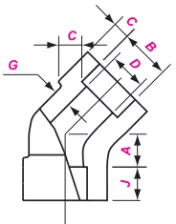
| Nominal size | Center to end face | End outer diameter | Wall thickness | Thread length | |||||||
| DN | NPS | A | H | G min | L2min | ||||||
| 45° elbow | |||||||||||
| 2000 | 3000 | 6000 | 2000 | 3000 | 6000 | 2000 | 3000 | 6000 | |||
| 6 | 1/8 | 17 | 17 | 19 | 22 | 22 | 25 | 3.18 | 3.18 | 6.35 | 6.7 |
| 8 | 1/4 | 17 | 19 | 22 | 22 | 25 | 33 | 3.18 | 3.3 | 6.6 | 10.2 |
| 10 | 3/8 | 19 | 22 | 25 | 25 | 33 | 38 | 3.18 | 3.51 | 6.98 | 10.4 |
| 15 | 1/2 | 22 | 25 | 28 | 33 | 38 | 46 | 3.18 | 4.09 | 8.15 | 13.6 |
| 20 | 3/4 | 25 | 28 | 33 | 38 | 46 | 56 | 3.18 | 4.32 | 8.53 | 13.9 |
| 25 | 1 | 28 | 33 | 35 | 46 | 56 | 62 | 3.68 | 4.98 | 9.93 | 17.3 |
| 32 | 1-1/4 | 33 | 35 | 43 | 56 | 62 | 75 | 3.89 | 5.28 | 10.59 | 18 |
| 40 | 1-1/2 | 35 | 43 | 44 | 62 | 75 | 84 | 4.01 | 5.56 | 11.07 | 18.4 |
| 50 | 2 | 43 | 44 | 52 | 75 | 84 | 102 | 4.27 | 7.14 | 12.09 | 19.2 |
| 65 | 2-1/2 | 52 | 52 | 64 | 92 | 102 | 121 | 5.61 | 7.65 | 15.29 | 28.9 |
| 80 | 3 | 64 | 64 | 79 | 109 | 121 | 146 | 5.99 | 8.84 | 16.64 | 30.5 |
| 100 | 4 | 79 | 79 | 79 | 146 | 152 | 152 | 6.55 | 11.18 | 18.67 | 33 |
IV. Key Differences Between 45-Degree and 90-Degree Threaded Elbows
Under the ASME B16.11 standard, although both 45-degree and 90-degree threaded elbows belong to the threaded elbow category, they differ significantly in structure, application, and performance. A detailed comparison is as follows:
1. Structure and Angle
The 45-degree elbow has a 45-degree angle between the center lines of its two ends, resulting in a smoother overall structure and a longer fluid turning path.
The 90-degree elbow has a 90-degree angle, forming a right angle, and a shorter and more direct turning path.
2. Fluid Resistance and Pressure Loss
Due to the smaller turning angle, the 45-degree elbow exhibits significantly lower resistance when conveying fluid compared to the 90-degree elbow, with pressure loss reduced by 30%-50%. This characteristic makes it more suitable for systems sensitive to pressure loss, such as high-precision hydraulic pipelines and metering pipelines;
while 90-degree elbows, due to their large turning angle and higher resistance, are more suitable for scenarios with limited space and lower requirements for pressure loss, such as drainage pipelines and low-pressure compressed air pipelines.
V. Common Types and Applications of Threaded Pipe Fittings
Except for 45-degree threaded elbows, the ASME B16.11 standard covers a variety of threaded pipe fittings, each with different functions, collectively forming a complete piping connection system. Common types and their applications are as follows:
1. 90-degree Threaded Elbow
Similar in function to a 45-degree elbow, used to achieve a 90-degree turn in the pipeline. Compact in structure, suitable for scenarios with limited space and where higher pressure loss is permissible.
2. Threaded Tee
Divided into equal diameter tees and reducing tees, used for branch connections in piping systems. Equal diameter tees are suitable when the main pipe and branch pipe have the same diameter; reducing tees are suitable when the branch pipe diameter is smaller than the main pipe.
3. Threaded Pipe Cap
Used for sealing the ends of pipes, preventing dust and impurities from entering the pipe or media leakage. Suitable for temporary pipe sealing or terminal sealing.
4. Threaded Pipe Coupling
Used to connect two pipe sections of the same diameter, extending pipe length. Suitable for short-distance connections during pipeline installation or repair of damaged pipes.
5. Threaded T-joints
Used to achieve bidirectional branching of pipelines, meaning the main pipeline branches simultaneously in two perpendicular directions, suitable for multi-path transportation in complex pipeline systems.
These threaded pipe fittings are widely used in petroleum, chemical, energy, construction, and shipbuilding industries due to their advantages of easy installation, good sealing performance, and strong compatibility. Especially in medium and low-pressure pipeline systems, they have become an important alternative to welded pipe fittings, reducing construction difficulty and improving the flexibility and maintainability of the pipeline system.