Hebei Shengtian Pipe Fittings Group Co., Ltd. has been specializing in the production and sales of ASME B16.9 standard butt-welded pipe fittings for many years. We provide customers with one-stop services including production, sales, transportation, and export. ASME B16.9 butt-welded tees are one of our key products, characterized by their robustness, durability, and excellent sealing performance, making them widely used in various industrial piping systems.
I. What is a Butt-Welded Tee?
A butt-welded tee has a "T" shape in appearance, consisting of a main pipe and a branch pipe connected perpendicularly to it. The English word "Tee" vividly reflects the appearance of the butt-welded tee.
The ends need to be beveled to facilitate welding to the pipe. The surface of the fitting usually requires sandblasting or shot blasting treatment. Carbon steel materials require anti-rust paint or other anti-corrosion treatment; the internal transition area is smooth to reduce fluid resistance and avoid eddies and scale buildup.
II. ASME B16.9 Types, Dimensions, and Weights of Weld-Butt Tees
ASME B16.9, published by the American Society of Mechanical Engineers (ASME), is the internationally recognized standard for the production of weld-butt tees, specifically for factory-made forged steel pipe fittings. This standard ensures the interchangeability, safety, and performance consistency of weld-butt tees.
1. Types of Steel Weld-Butt Tees
Equal Diameter Tees: The outer diameter of the main pipe and branch pipe are the same. Suitable for applications requiring equal flow distribution, resulting in a relatively uniform flow field.
Reducing Tees: The outer diameter of the branch pipe is smaller than that of the main pipe. Commonly used in applications requiring branching to smaller flow rates. The designation is "main pipe diameter × branch pipe diameter".
2. ASME B16.9 Weld-Butt Tee Dimensions
ASME B16.9 specifies a series of dimensions for weld-butt tees, primarily including:
Nominal Diameter: Covering sizes from NPS 1/2″ to NPS 48″ (DN15 to DN1200).
Dimensional tolerances: Strictly defined allowable deviations for port outer diameter, inner diameter, bevel angle, and center-to-end face distance (e.g., the C dimension of an equal-diameter tee) ensure the accuracy of the weld joint.
Wall thickness: typically matched to the wall thickness of the connected pipe. Standard tees are available in "Standard Wall Thickness" (STD) and "Extra Thickness" (XS) series to meet different pressure rating requirements.
Butt-welded tees conforming to ASME B16.9 are dimensionally fully compatible with pipes, valves, and other fittings of the same standard, achieving standardized system design and installation.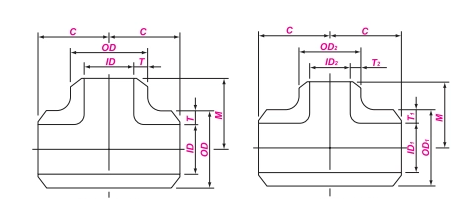
3. Theoretical Weight Table
4. Tolerance range for butt welded pipe fittings according to ASME B16.9
|
Nominal Size |
All Fittings |
45°&90° Elbows & Tees, Crosses |
3D Radius Elbows |
Returns |
Caps |
Reducers & Lap Joint Stub Ends |
Lap Joint Stub Ends |
||||||
| DN | NPS | OD 3) 4) | ID 3) | A B C M | A B |  O O |
K | U | E, E1 | H F | G |
R | t |
| 15-65 | 1/2 -21/2 | +1.6 -0.8 |
± 0.8 | ± 2 | ± 3 | ± 6 | ± 6 | ± 1 | ± 3 | ± 2 | 0 -1 |
0 -1 |
+1.6 0 |
| 80-90 | 3-31/2 | ± 1.6 | ± 1.6 | ± 2 | ± 3 | ± 6 | ± 6 | ± 1 | ± 3 | ± 2 | 0 -1 |
0 -1 |
+1.6 0 |
| 100 | 4 | ± 1.6 | ± 1.6 | ± 2 | ± 3 | ± 6 | ± 6 | ± 1 | ± 3 | ± 2 | 0 -1 |
0 -2 |
+1.6 0 |
| 125-200 | 5-8 | +2.4 -1.6 |
± 1.6 | ± 2 | ± 3 | ± 6 | ± 6 | ± 1 | ± 6 | ± 2 | 0 -1 |
0 -2 |
+1.6 0 |
| 250-450 | 10-18 | +4.0 -3.2 |
± 3.2 | ± 2 | ± 3 | ± 10 | ± 6 | ± 2 | ± 6 | ± 2 | 0 -2 |
0 -2 |
+3.2 0 |
| 500-600 | 20-24 | +6.4 -4.8 |
± 4.8 | ± 2 | ± 3 | ± 10 | ± 6 | ± 2 | ± 6 | ± 2 | 0 -2 |
0 -2 |
+3.2 0 |
| 650-750 | 26-30 | +6.4 -4.8 |
± 4.8 | ± 3 | ± 6 | --- | --- | --- | ± 10 | ± 5 | --- | --- | --- |
| 800-1200 | 32-48 | +6.4 -4.8 |
± 4.8 | ± 5 | ± 6 | --- | --- | --- | ± 10 | ± 5 | --- | --- | --- |
1. Carbon Steel Welded Butt Tees:
20# Steel/A106 Gr.B: The most commonly used carbon steel material, with good weldability and mechanical properties, suitable for general water, steam, oil, and other media, with a wide temperature range.
Q235B: A commonly used carbon steel in Chinese standards, offering high cost-effectiveness, used in low-pressure general fluid systems.
2. Stainless Steel ASME B16.9 Tees:
304/304L: General-purpose austenitic stainless steel, with excellent corrosion resistance and formability, suitable for food, chemical, and general corrosive environments.
316/316L: Contains molybdenum, with significantly better resistance to pitting and chloride corrosion than 304, suitable for more demanding conditions such as marine environments and chemical plants.
321: Contains titanium, with strong resistance to intergranular corrosion, suitable for high-temperature environments.
3. Alloy Steel BW Tees:
16Mn (Q345B/C/D): Low-alloy high-strength steel with superior comprehensive mechanical properties compared to ordinary carbon steel, commonly used in oil and gas pipelines with certain pressure requirements.
15CrMoG, P91, etc.: Heat-resistant alloy steels with excellent creep strength and oxidation resistance under high temperature and pressure, specifically used in power plant boilers, high-temperature steam pipelines, etc.
4. Other Special Materials:
Such as duplex stainless steel (2205), nickel-based alloys (Inconel 600/625), etc., used in extreme corrosive or high-temperature environments.
Material selection requires comprehensive consideration of design pressure, design temperature, fluid corrosivity, process requirements, and cost factors.
IV. Application Scope The superior performance of welded tees makes them play a core role in many industrial fields:
Oil and Gas Industry: Used for diversion, gathering, and process switching in long-distance pipelines for crude oil, natural gas, and refined oil, as well as in process pipelines of refineries and chemical plants.
Chemical and Petrochemical Industries: Connecting various reactors, towers, and heat exchangers, and transporting various chemical raw materials, intermediates, and products, the selection of corrosion-resistant materials is crucial.
Power Industry: High-quality alloy steel tees are indispensable in the steam and feedwater systems of thermal power plants and the auxiliary pipelines of nuclear power plants, especially in the main steam pipelines under high temperature and pressure.
Shipbuilding and Marine Engineering: Used in the power systems (fuel oil, lubricating oil), ballast water systems, and oil and gas handling and transportation systems of offshore platforms.
Municipal Construction: Used in the main and branch lines of centralized heating networks to achieve efficient heat distribution.
Food and Pharmaceutical Industries: Primarily using sanitary-grade stainless steel tees to meet the stringent requirements of sterility, residue-free operation, and easy cleaning in fluid transportation.
Other Fields: Also includes papermaking, metallurgy, air conditioning, and environmental engineering.
Welded tees, as a high-efficiency and reliable pipe fitting, ensure the safe, efficient, and long-term stable operation of modern industrial pipeline systems through their strict adherence to the ASME B16.9 standard, diverse material selection, and wide range of applications.
 GOST 12820 Steel Plate Flanges
 DIN2573 PN6 Plate Flange
 GOST 12836 Blind Flange Dimensions PN40 4.0Mpa